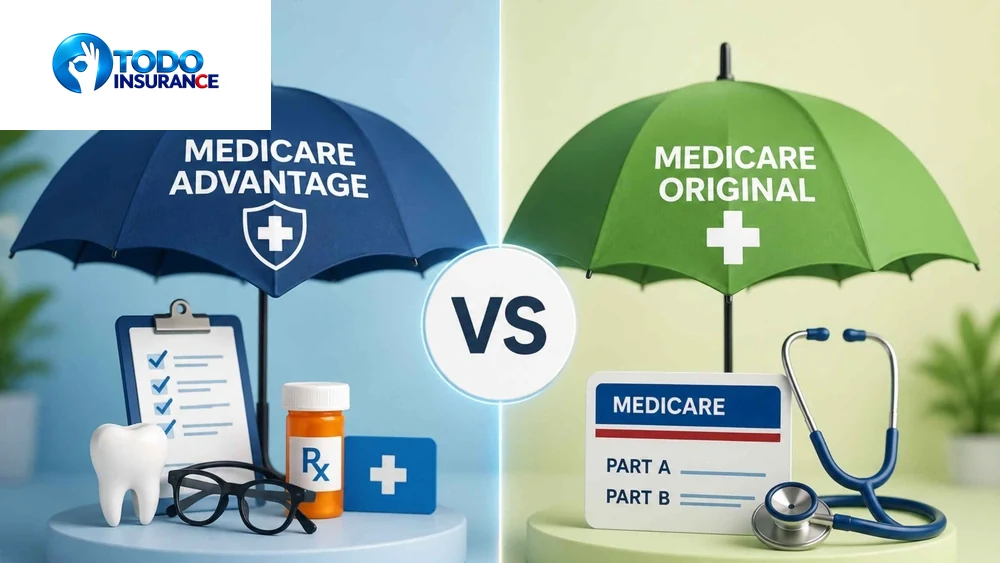

Adapted from the original Todo Insurance blog. Educational information: verify current rules and documents before applying for or changing coverage.
Part C refers to Medicare Advantage, a coverage option available to people enrolled in Medicare. Under this type of plan, healthcare benefits are administered by Medicare-approved private health insurers rather than through the Original Medicare program. Medicare Advantage plans are required to provide the same basic coverage as Original Medicare. Depending on the plan, members may also have access to services that Original Medicare generally does not include, such as dental, vision, hearing, and prescription drug benefits. Enrollment is voluntary and open to anyone already enrolled in Medicare Parts A and B.
Medicare as a Starting Point
To understand what Medicare Advantage is, it helps to start with what it is an alternative to. Original Medicare provides federally administered health coverage primarily for adults who are 65 or older. Certain individuals under 65 may also qualify if they have specific disabilities or medical conditions that meet Medicare’s eligibility requirements. Original Medicare is divided into Part A and Part B, with each one covering different types of healthcare. Part A helps pay for inpatient services, skilled nursing care, and certain home health services, while Part B generally covers outpatient care, physician visits, preventive services, and medical equipment.
Original Medicare is administered directly by the federal government. When you receive covered services, Medicare processes the claim and pays its share. The program has broad reach — most hospitals and doctors in the United States accept it — but it also has gaps. With Original Medicare, healthcare costs can continue to add up because there is no annual out-of-pocket maximum for covered services. In addition, beneficiaries generally need separate coverage for expenses such as prescription drugs, routine dental care, vision services, and hearing care.
Medicare Advantage emerged as a way to fill those gaps while consolidating coverage into a single plan administered by a private insurer. The federal government pays the insurer a set amount per month to provide your Medicare benefits, and the insurer builds a plan around those requirements — often adding extra benefits to attract enrollees.
What Medicare Part C Actually Means
The label Part C refers to the section of the Medicare statute that authorizes private insurers to offer Medicare benefits as an alternative to the federal program. It is not a separate benefit category the way Parts A and B are — it is the legal framework that allows the Medicare Advantage system to exist.
When you enroll in a Medicare Advantage plan, you are still enrolled in Medicare. Even with this coverage, Medicare Part B premiums continue to be paid to the federal government. What changes is how your benefits are delivered: instead of the federal government processing your claims, the private insurer you enrolled with does. In exchange, you follow the rules of that plan — its provider network, its referral requirements, its cost-sharing structure.
What Medicare Advantage Plans Must Cover
By law, every Medicare Advantage plan must cover all services that are covered under Original Medicare Parts A and B. This is a floor, not a ceiling. A Medicare Advantage plan cannot offer less than Original Medicare — it can only offer the same or more. The federal government audits plans regularly to ensure compliance with this requirement.
In practice, most Medicare Advantage plans do offer more. The most common additions are prescription drug coverage — which is typically included as an integrated Part D benefit — and supplemental benefits such as routine dental care, eye exams, eyewear, hearing exams, and hearing aids. Some plans go further with benefits like fitness memberships, transportation to medical appointments, over-the-counter allowances, and meal delivery for members recovering from illness.
Note: Not every plan available in a given area will offer the same extra benefits. The extras vary significantly between plans and between counties. Verifying what a specific plan actually includes — not just what the plan type generally offers — is essential before enrolling.
The Provider Network Difference
One key distinction between Medicare Advantage and Original Medicare is how each program handles access to doctors, hospitals, and other healthcare providers. Under Original Medicare, you can see any doctor or visit any hospital in the United States that accepts Medicare — and nearly all do. There are no network restrictions, no referrals required, and no prior authorization needed for most services.
Medicare Advantage plans typically operate within defined networks. HMO-type plans generally require you to use in-network providers for non-emergency care and to get referrals from a primary care physician before seeing a specialist. PPO-type plans allow out-of-network visits but at higher cost. For someone who travels frequently, sees multiple specialists across different health systems, or has a long-established relationship with specific providers, these network constraints matter and are worth evaluating carefully before choosing a plan.
Cost Structure: How Medicare Advantage Plans Price Their Benefits
Medicare Advantage plans typically come with a lower monthly premium than what you might expect — some plans have zero additional premium beyond the Part B amount you already pay to Medicare. This is possible because the federal government’s per-member payment to the insurer subsidizes the plan’s operating costs.
The trade-off is that Medicare Advantage plans have their own cost-sharing structure: copayments for doctor visits, coinsurance for hospital stays, and a plan-specific out-of-pocket maximum. Once you reach that maximum in a given year, the plan covers 100% of covered services for the remainder of that year. Original Medicare, by contrast, has no out-of-pocket maximum — your costs can continue to grow without a ceiling if you have a serious illness or extended hospital stay.
For many enrollees, particularly those in reasonably good health who use a moderate amount of medical care, a Medicare Advantage plan can result in lower total annual spending than Original Medicare plus a standalone Part D drug plan and a Medigap supplement. The comparison depends heavily on the specific plan, the person’s health needs, and the providers they use.
Who Is Eligible for Medicare Advantage?
To enroll in a Medicare Advantage plan, you must be enrolled in both Medicare Part A and Part B and live within the service area of the plan you are considering. Most people become eligible for Medicare at age 65. Younger individuals with certain qualifying disabilities or conditions — including End-Stage Renal Disease and ALS — may also be eligible for both Medicare and Medicare Advantage, depending on the specific circumstances.
Enrollment happens through a set of specific enrollment periods. The Initial Enrollment Period opens when you first become eligible for Medicare. Medicare’s Annual Enrollment Period takes place each fall, from October 15 through December 7. Changes made during this window typically become effective the following January. An insurance advisor can confirm which enrollment window applies to your specific situation.
What people ask us about Medicare Advantage
Is Medicare Advantage the same as Medicare?
Medicare Advantage is an alternative way to receive your Medicare benefits, not a separate program. You remain enrolled in Medicare when you join a Medicare Advantage plan. The difference is that a private insurer approved by the federal government delivers your benefits instead of the federal program directly.
Does Medicare Advantage replace Original Medicare?
For the time you are enrolled in a Medicare Advantage plan, the plan delivers your Medicare benefits instead of Original Medicare. You remain on Medicare and continue paying your Part B premium. You can return to Original Medicare during specific enrollment periods.
Do all Medicare Advantage plans include prescription drug coverage?
Prescription drug coverage is included in many Medicare Advantage plans, although some plans do not offer Part D benefits. If a plan does not include drug coverage, you would need a separate Part D plan to cover prescriptions. Verify drug coverage when comparing plans.
Can I see any doctor with Medicare Advantage?
It depends on the plan type. MO plans generally limit coverage to doctors and facilities within their network and may require a referral before you can see a specialist. PPO plans offer greater flexibility, allowing you to seek care outside the network, although doing so usually means paying more. Unlike Original Medicare, most Medicare Advantage plans have network restrictions that limit your provider choices.
Are there Medicare Advantage plans with no monthly premium?
Yes. Some Medicare Advantage plans have zero additional monthly premium beyond what you already pay for Part B. These plans are available in many areas and funded largely through the federal government’s per-member payment to the insurer. Coverage and benefits vary, so zero premium alone is not a complete evaluation criterion.
Can I switch back to Original Medicare after joining Medicare Advantage?
Yes. If you decide that Original Medicare better suits your needs, there are specific periods when you can leave a Medicare Advantage plan. These include the Annual Enrollment Period, from October 15 through December 7, and the Medicare Advantage Open Enrollment Period, which runs from January 1 through March 31. An insurance advisor can explain what to consider before making that change.
What extra benefits do Medicare Advantage plans typically offer?
Common additions include prescription drug coverage, routine dental care, vision exams and eyewear, hearing exams and hearing aids, and fitness memberships. Some plans also include transportation to appointments, over-the-counter allowances, and other supplemental benefits. The specific extras vary by plan and location.
Thinking About Medicare Advantage? Let’s Look at Your Options
Whether Medicare Advantage is the right choice depends on your health needs, the providers you see, and what plans are available in your area. A Todo Insurance advisor can walk you through what is offered in your county, compare the benefit structures, and help you make a well-informed decision before your enrollment window closes.
Prepare a free inquiry and share it with Todo Insurance by email or WhatsApp. You can also call (786) 522-7899. Preparing the summary does not send a request or activate coverage. Prepare my inquiry.